Last updated November 17, 2026


Free written scope consultation - allowances, timeline, and change-order rules on paper before a single trade is scheduled
Driveway & Pavers Maintenance Checklist for North Miami Beach Homeowners
A paver driveway that looks perfect in year one can be shifting, staining, and crumbling by year three in North Miami Beach. Not because of bad installation, but because homeowners are following maintenance advice written for the wrong climate entirely. Most checklists you’ll find online come from the Midwest or Northeast, where the big enemy is frost heave and the annual cycle of freeze-and-thaw. Here in South Florida, that advice is useless. Our enemies are UV oxidation, salt infiltration, tropical downpours, and weeds that grow twelve months a year. This guide covers what actually destroys pavers on North Miami Beach properties, and the schedule that keeps them intact.
Quick Answer
Paver driveways in North Miami Beach need joint sand replenishment every one to two years, a full penetrating seal every 18 to 24 months (not the 3 to 5 years many national manufacturers recommend), quarterly weed checks, and efflorescence treatment the moment white haze appears. Skip the power wash unless you know what you’re doing; high pressure on older or tumbled pavers strips the surface and makes everything worse.
Styles & brands we work with
- Kitchen remodeling
- Bathroom remodeling
- Home additions & ADU
- Roofing
- Windows & doors
- Driveway & pavers
- Fence
Table of Contents
- Why Paver Maintenance in North Miami Beach Is a Different Job
- The Sealing Schedule That Actually Works Here
- Efflorescence: Catching It Before It Goes Structural
- Joint Sand After a Tropical Storm: What Holds, What Washes Out
- Salt Air Oxidation and the Coastal Discoloration Pattern
- When a Power Wash Does More Damage Than the Dirt
- Weed Control on a Year-Round Growing Season
- The North Miami Beach Seasonal Checklist
Why Paver Maintenance in North Miami Beach Is a Different Job
Start with the sun. South Florida’s UV index regularly pushes into the extreme range from April through October, and that’s not just a sunburn advisory for people. It’s an oxidation clock for the binder in your pavers and your sealant. A penetrating sealer that would last three to four years in Charlotte or Columbus breaks down in half that time under Miami-Dade sun, rain, and heat cycling. National product labels simply don’t account for it.
Then there’s the water. North Miami Beach sits on the Biscayne Aquifer with a water table that stays high most of the year. After a summer downpour, water percolates down through the paver joints, sits against the base, and then evaporates back upward carrying dissolved minerals with it. That up-and-down cycle happens dozens of times per rainy season. It’s the engine behind efflorescence, joint sand loss, and the slow settling you see in low spots along the driveway edge.
Salt is the third factor, and only properties within roughly a mile of the Intracoastal or Biscayne Bay feel it fully. Airborne salt settles on paver surfaces, dries into a fine crystalline film, and interacts with the cementitious binder in the pavers over time. That’s why coastal North Miami Beach neighborhoods like Eastern Shores and Keystone Point show more surface discoloration than comparable inland driveways of the same age.
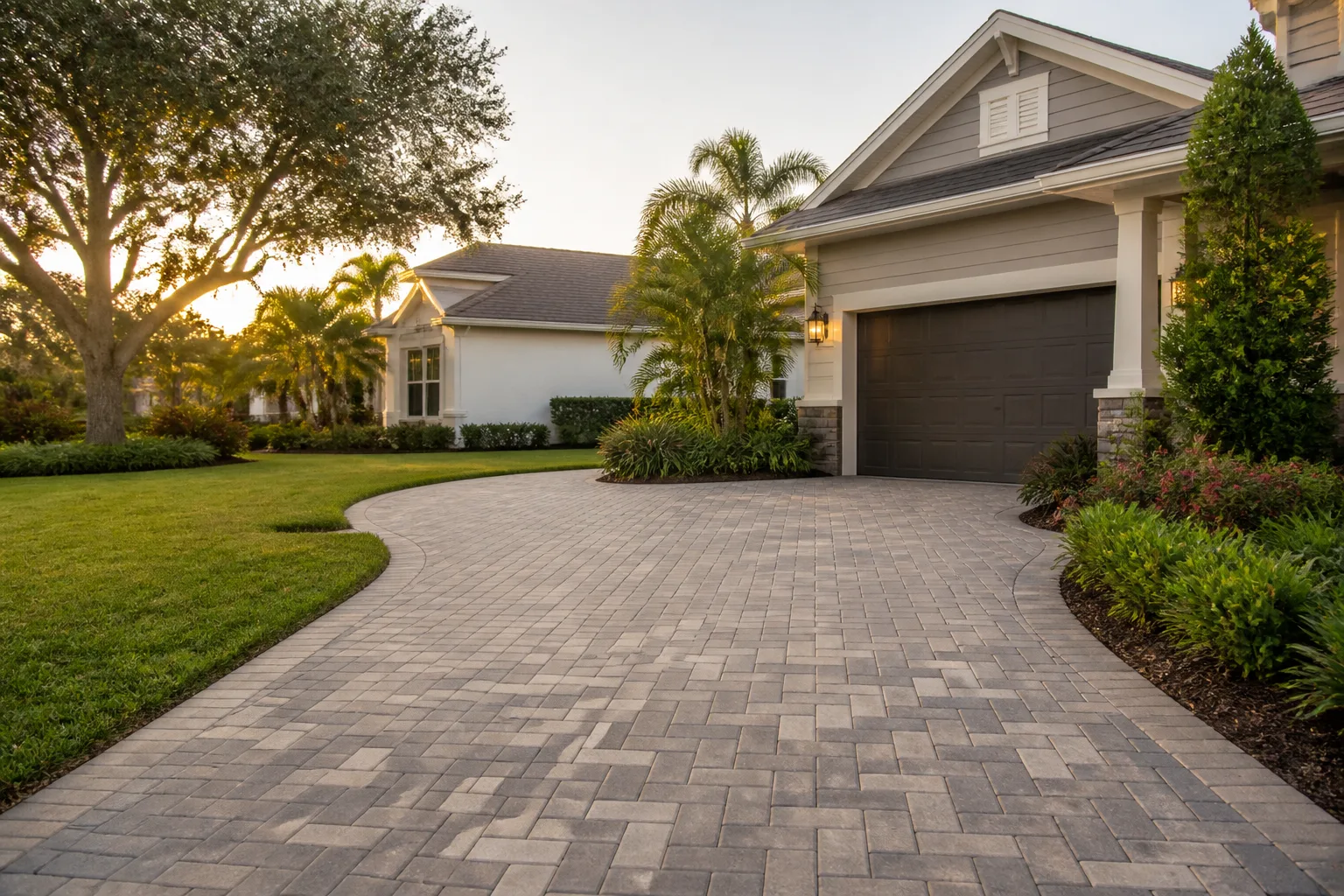
None of this means pavers were a bad choice. They’re still one of the best driveway surfaces for South Florida when maintained correctly. Our crews handle driveway & pavers in North Miami Beach regularly, and well-maintained paver driveways easily outlast poured concrete in this climate. The key is that the maintenance schedule has to match the climate, not the label.
The Sealing Schedule That Actually Works Here
Here’s the number that surprises most North Miami Beach homeowners: seal your pavers every 18 to 24 months, not every three to five. Manufacturer data on sealant longevity is tested in milder climates. Under the UV and rain load we get in South Florida, a penetrating sealer is effectively spent by the second summer.
You can test it yourself. Pour a small cup of water on the pavers after they’ve dried for a full day. If the water beads and sits, the seal is still doing its job. If it soaks in within a minute or two, the sealer has broken down and it’s time to reseal. This is the single most reliable diagnostic we know and it costs nothing.
Two types of sealer dominate the market and they behave very differently here:
- Penetrating sealers soak into the paver and protect from the inside. They don’t change color or create a film, and they let the surface breathe, which matters in a humid climate where trapped moisture causes spalling.
- Film-forming sealers sit on top and can look glossy for a while, but they trap moisture, yellow under UV, and can flake. On a North Miami Beach driveway getting hit by afternoon thunderstorms six months out of the year, film-formers often fail faster than penetrating products.
For most properties here, we recommend a penetrating sealer on a 24-month cycle, and a 18-month cycle for driveways within a half-mile of the water where salt load is highest. Seal in the dry season (November through March), never right before a forecasted rain event. Two coats with proper dry time between them, product matched to the specific paver type. Quikrete and Sakrete both make seal and joint sand products that hold up well here when applied correctly.
Efflorescence: Catching It Before It Goes Structural
Efflorescence is that white powdery haze that shows up on paver surfaces and joints. It’s mineral salt pushed to the surface by moisture migrating from below. A little is cosmetic. A lot, left untreated through multiple humidity cycles, can indicate ongoing moisture problems in the base and eventually lead to spalling, joint failure, and surface flaking.
North Miami Beach humidity runs high year-round and our rainy season delivers 40-plus inches of rain in five months. That’s a lot of moisture cycling through pavers. Efflorescence here shows up faster and recurs more often than in drier climates, so the treatment window is tighter.
Here’s the sequence that works:
- Identify it’s actually efflorescence. It’s white and powdery. If you can brush some off with your hand or a stiff-bristle broom, it’s efflorescence. If it’s darker, harder, and won’t come off, it’s something else (likely staining or a sealer failure) and needs a different approach.
- Dry-brush first. A stiff broom removes light efflorescence without introducing more water, which is the opposite of what you want when treating efflorescence.
- Use a dedicated efflorescence remover, diluted per label. These are mild acids. They work, but they etch surfaces if left too long or used too concentrated. Rinse thoroughly.
- Address the source. If efflorescence keeps returning in the same area, water is getting in from somewhere: a downspout discharging onto the driveway, a low spot that puddles, or a joint that’s lost its sand. Fix the water path or it comes right back.
- Seal only after the surface is fully dry and efflorescence-free. Sealing over active efflorescence traps it and makes the next treatment harder.
If efflorescence keeps coming back in the same 10 square feet after two treatment cycles, stop treating and call someone who can diagnose the water problem underneath. That pattern almost always means base saturation.
Joint Sand After a Tropical Storm: What Holds, What Washes Out
Joint sand is what locks pavers together and keeps them from shifting. In North Miami Beach, we lose joint sand to two things: rain impact and water penetration from underneath. A single hurricane or a strong tropical system can strip a visible amount of sand from exposed joints in a couple of hours.
The type of sand matters enormously here. Regular mason sand washes out fast in heavy rain. Polymeric sand, which sets up with a binder when wetted, holds up far better through Florida downpours, but only if it’s installed correctly: joints filled to within 1/8 inch of the top, compacted, swept, misted properly to activate the binder, and allowed to cure without rain for the required window. Get any of those steps wrong and polymeric sand fails too, sometimes worse than plain sand because it can form a loose crust that crumbles.
After any named storm or a stretch of heavy rain, do this check:
- Walk the driveway and look for joints that are visibly low or have open gaps.
- Look for sand accumulation at the low end of the driveway or at the street apron. That’s your sand leaving.
- Check for pavers that rock underfoot or have shifted out of plane. That’s a bigger sign than lost sand and usually means base settlement.
If joints need topping off, use the same type of sand already in them. Mixing polymeric on top of mason sand, or vice versa, creates a weak bond. If you’re not sure what’s in there, a paving contractor can identify it in a couple of minutes.
Salt Air Oxidation and the Coastal Discoloration Pattern
Driveways in coastal North Miami Beach neighborhoods develop a specific look after five or six years: a mottled, slightly bleached appearance, often worse on the side of the driveway that faces the bay or ocean. This isn’t dirt. It’s salt air oxidation, and it’s normal for coastal pavers.
The pattern is the tell. Salt-loaded air comes in on the prevailing breeze, so the oxidation is usually heaviest on the windward face of the property. Inland driveways (think properties west of Biscayne Boulevard in North Miami Beach) show far less of it. That directional difference is how you know you’re looking at salt oxidation and not a general wear or cleaning issue.
Distinguish cosmetic from structural this way:
- Cosmetic: Color is faded or bleached but the surface is intact, pavers are solid underfoot, joints are full, no pieces are flaking off. You can improve the appearance with a color-enhancing sealer (which also slows further oxidation).
- Structural: Surface is flaking, sandy, or pitted; edges are crumbling; visible efflorescence is combined with spalling; pavers are rocking. That’s not oxidation alone, and it needs hands-on evaluation.
A color-enhancing penetrating sealer every 18 to 24 months on coastal driveways does double duty: it restores some of the lost color and slows the oxidation rate by blocking direct UV and salt contact. That’s the most cost-effective intervention we know for North Miami Beach coastal driveways.
When a Power Wash Does More Damage Than the Dirt
Power washing is the most common maintenance mistake we see on North Miami Beach driveways. On older concrete pavers, tumbled pavers, or anything with a decorative surface, high pressure strips the top layer, opens the surface pores, blows out joint sand, and creates a surface that stains faster afterward than before you started.
The rule: match pressure to paver type, or don’t use a pressure washer at all.
- Modern smooth concrete pavers can usually handle moderate pressure (under 2,000 PSI) with a wide fan tip, held at a shallow angle.
- Tumbled or antiqued pavers (very common in North Miami Beach neighborhoods) should never be hit with more than a garden hose, a soft-bristle brush, and a mild paver cleaner. The textured surface holds dirt but is fragile, and a pressure washer removes the tumbled finish permanently.
- Clay pavers and travertine need low pressure and the right cleaner. A generic degreaser can etch either one.
- Any paver with visible efflorescence should never be pressure-washed. Pressure drives water deeper into the slab and makes the efflorescence worse, plus it removes any sealer still in place.
If your driveway has visible joint erosion after washing, you’ve just made the situation worse. Stop, re-sand, and re-seal. If you’ve already damaged the surface, get an evaluation before you spend more money on DIY fixes that can’t restore the damaged top layer.
Weed Control on a Year-Round Growing Season
In most of the country, winter kills weeds in the joints. Not in North Miami Beach. Our growing season is twelve months, so a weed problem you ignore in January is a weed problem in July. Every joint that loses sand becomes a germination site within weeks.
The control strategy that works:
- Keep joint sand full. Full joints are the single best weed control you have. Weeds need bare soil and a crack. Take away the crack and the problem drops by 90%.
- Quarterly walkthrough. Every three months, walk the driveway with a stiff broom and pull anything green that’s emerged. This takes fifteen minutes and prevents hours of work later.
- Spot-treat with vinegar or a paver-safe herbicide. Household vinegar (5% acetic acid) kills small weeds and is safe for the pavers if it’s not left pooling. For larger root systems, use a paver-safe herbicide per the label. Never use a long-residual total vegetation killer near beds or turf you want to keep.
- Never use a string trimmer on the driveway edge. The single biggest cause of paver edge chipping we see is weed-eating. Hand-pull along edges or use a blade-style edger at a shallow angle.
New paver driveways sometimes use a jointing product with built-in weed resistance, and Cover make a joint stabilizer sand that many installers use. That helps but doesn’t replace maintenance: it slows the germination, doesn’t stop it. Plan on the quarterly walk regardless.
The North Miami Beach Seasonal Checklist
If you do nothing else, run through this on the calendar each year. It takes an hour on the quick checks and covers what actually matters in our climate.
Quarterly (every three months):
- Walk the full driveway, pulling weeds and checking for rocking pavers.
- Inspect joints for lost sand and top off any that are visibly low.
- Look for new efflorescence and treat at first sign.
Dry season (November through March):
- This is sealing season. Confirm the pavers are clean and dry, then apply seal according to the 18 to 24 month cycle (or 18 months if you’re coastal).
- Prune tree and shrub roots away from the driveway edge if you’re seeing heave.
- Check gutter downspouts: any that discharge onto the pavers are directing water into the base and creating efflorescence long-term.
Before and after hurricane season (June 1 to November 30):
- Pre-season: top off joint sand, verify any loose pavers are re-set. Loose pavers become flying paver corners in a wind event.
- Post-storm: walk the driveway after every named system and top off sand in the first dry week. If pavers shifted, get a diagnosis rather than just pushing them back into place.
- After the season, do a full inspection before major sealing work. Winter dry season is the right window.
One additional North Miami Beach note: our regulatory environment is specific. Some work on residential driveways near the right-of-way requires permitting through the City of North Miami Beach, and any change to drainage patterns at the property edge can trigger review. Cosmetic maintenance doesn’t, but anything that involves the driveway apron or elevations does. Ask before you dig.
Common Mistakes to Avoid
- Using a pressure washer on tumbled pavers. The tumbled finish is a surface treatment, and high pressure strips it permanently. Once it’s gone, no amount of resealing brings it back.
- Sealing on the manufacturer-recommended three to five year cycle. That’s a number for cooler, drier climates. In North Miami Beach, your sealer is dead by two years.
- Treating efflorescence with more water. Efflorescence is a moisture problem. Mopping or power-washing over it just pushes more water into the base and pulls more minerals up.
- Ignoring a single rocking paver. A rocking paver is a failure signal at the base. Left alone through a rainy season, one rocking paver becomes a settled corner of the driveway. Fix the base, not the paver.
- Mixing sand types in the joints. Polymeric on top of mason sand, or the reverse, creates a weak bond and predictable failure. Use the same type that’s already in the joints.
- Landscaping that traps moisture against the driveway. Mulch piled against the driveway edge or hedges planted within 12 inches of pavers hold moisture and drive efflorescence and organic staining along the border. Also a termite problem waiting to happen.
- Skipping the post-storm walk. We routinely see North Miami Beach driveways where six months of joint sand erosion went unattended after a storm. That’s now a resand-plus-reset job instead of a resand job.
- Not knowing the paver type you have. A $200 maintenance decision can turn into a $2,400 replacement because the wrong product was used. Write down the paver brand, style, and color the day you buy or install so you can match it later. If you didn’t install it, a paver contractor can identify the product by eye in most cases.
See the difference
 Before
 After
 Before
 After
 Before
 After
When to Call a Professional
Most of this checklist is DIY-able with a stiff broom, a garden hose, and a few hours each season. Call a professional when you see any of these:
- Pavers that rock underfoot, are visibly heaved, or have sunk into a localized low spot (that’s base failure, and no amount of maintenance fixes it).
- Efflorescence that returns to the same area after two treatment cycles.
- Joints that lose sand faster than every few months.
- Surface spalling, flaking, or crumbling on more than a couple of pavers.
- Any driveway near a pool, retaining wall, or property line where water or structure is at stake.
- Damage after a named storm where pavers have shifted or the driveway edge has been undermined.
Groundwork Construction Co. of North Miami Beach offers free estimates in North Miami Beach – call (844) 797-4868. All driveway work backed by the 730-Day Done Right Promise, upfront pricing with no surprises, and calls answered by a live person 24/7.
We also handle the surrounding property. If the driveway edge is failing because the fencing is holding water against it, fence installation in North Miami Beach can correct grading and water flow. For larger properties with detached garages or ADUs, home additions & ADU in North Miami Beach handles the driveway-to-structure transition cleanly. And to see everything we do, visit Groundwork Construction Co. of North Miami Beach home.
Frequently Asked Questions
Every 18 to 24 months, not the three to five years most manufacturer labels suggest. South Florida’s extreme UV index and heavy summer rains break down the sealer twice as fast as in cooler climates. Coastal properties near the Intracoastal or bay should lean toward 18 months, inland properties can go 24 months. Test with a cup of water: if it doesn’t bead, it’s time. Call (844) 797-4868 for a free evaluation of your current sealer condition.
That’s efflorescence, mineral salt pushed to the surface by moisture migrating from below. It’s cosmetic in early stages and treatable with a diluted efflorescence remover plus a stiff broom. If it returns to the same area repeatedly after two treatment cycles, it indicates a moisture problem in the base that needs a professional diagnosis. Call (844) 797-4868 for a free assessment.
Yes on smooth modern concrete pavers at moderate pressure, no on tumbled, antiqued, clay, travertine, or any paver showing efflorescence. Tumbled pavers common in North Miami Beach neighborhoods have a textured surface that high pressure strips permanently. If you’re not certain of your paver type, don’t pressure wash it. Call (844) 797-4868 for a free evaluation to identify the correct cleaning method.
Cosmetic issues are color fading, mild staining, or light efflorescence on intact pavers with full joints and no movement. Structural issues are rocking pavers, visible heave, sinking, surface spalling, or joints that lose sand within weeks. Rocking and settling always mean base problems. Call (844) 797-4868 for a free diagnosis before structural issues get worse.
Salt air oxidation. Prevailing winds carry airborne salt onto pavers and cause a mottled, bleached appearance on the windward side of coastal properties. It’s cosmetic in most cases and responds well to a color-enhancing penetrating sealer every 18 to 24 months. If the surface is flaking or sandy to the touch, that’s spalling and needs evaluation. Call (844) 797-4868 for a free review.
Cosmetic maintenance (cleaning, sealing, joint sand, weed control) never requires a permit. Any change to the driveway footprint, the apron at the right of way, elevations, or drainage patterns does typically require City of North Miami Beach permitting and can trigger review of how water flows at the property edge. Any contractor you hire should handle permitting and inspection as part of the job, and Groundwork Construction Co. of North Miami Beach does. Call (844) 797-4868 for a free estimate that includes the permit scope.
Basic cleaning and resealing for a standard two-car driveway runs roughly $400 to $900 depending on square footage and prep work needed. Joint sand replenishment adds $150 to $400. Efflorescence treatment on top of that runs $100 to $300. Full paver reset or base repair is a larger job and priced after inspection. Groundwork Construction Co. of North Miami Beach gives a written line-item quote upfront, no change orders, and the number you see is the number you pay. Call (844) 797-4868 for a free estimate.
The Bottom Line
Paver maintenance in North Miami Beach isn’t the same job as it is anywhere else. Your climate compresses the maintenance cycle, amplifies the failure modes, and punishes generic advice. Seal on a 18 to 24 month cycle, not five years. Treat efflorescence the moment you see it, not next season. Top off joint sand after every storm. Don’t pressure-wash tumbled pavers. And don’t ignore a rocking paver: that’s a base problem and it only gets worse. All of this work is protected by our 730-Day Done Right Promise, so if it isn’t done right, we make it right. It’s the same guarantee we put behind every driveway, fence, addition, and roof we install across North Miami Beach.
Call (844) 797-4868 to schedule your free estimate in North Miami Beach. Live person, 24/7. Upfront pricing with no surprises. From foundation to finish line.
Written by the team at Groundwork Construction Co. of North Miami Beach.